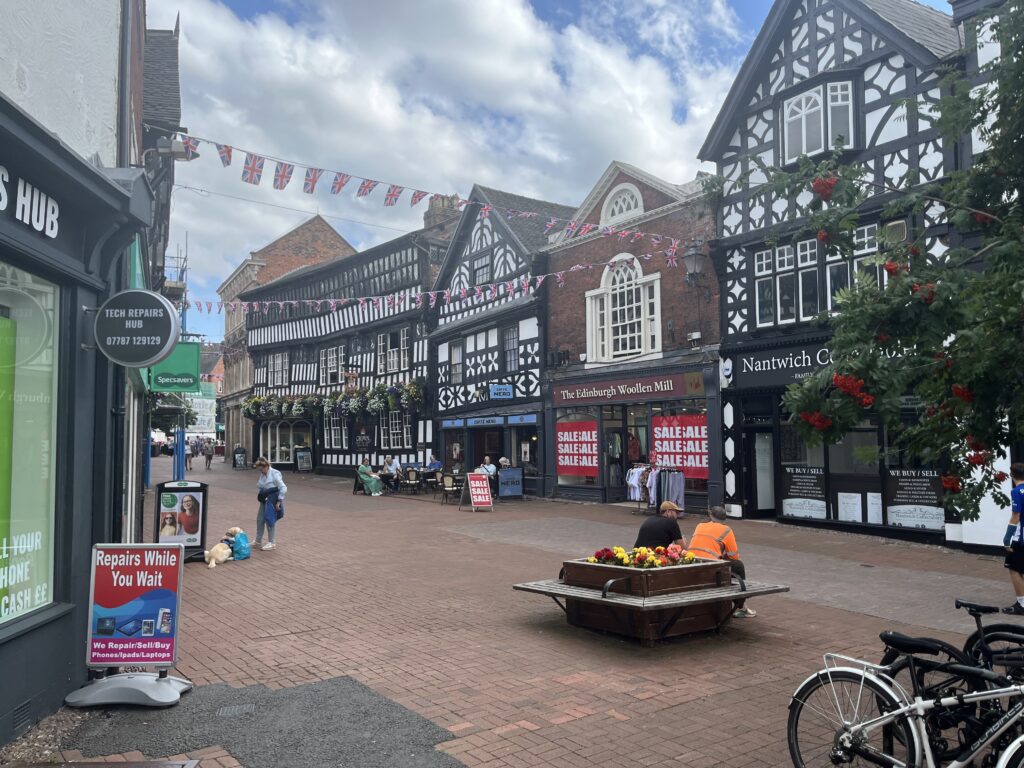
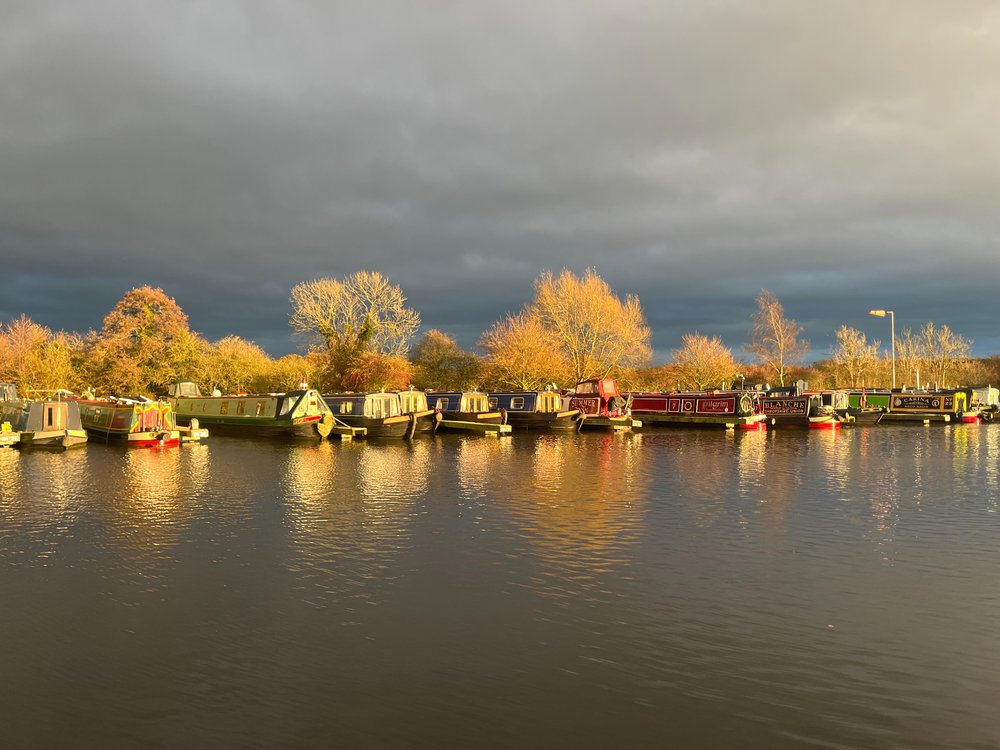
A blur crossed my peripheral vision as I closed the lock gate behind Mary Joan. It was Indy, a German Shepherd-Collie crossbreed bounding at full speed. She is owned by Tracy, the proprietor of Clayways, where I’d continued to learn about pottery making while the boat was moored in Swanley Bridge Marina near Nantwich during the winter.
The blur was followed by a splash as Indy failed in her attempt to leap the nine feet width of the lock. Tracy, her husband Dave, Jess (Tracy’s assistant) and her friend Lewis, had kindly agreed to help me through the fifteen locks of the Audlem Flight on the Shropshire Union Canal as I began travelling south.
Dave and Lewis had walked on ahead to prepare the next lock while Tracy and Jess were sat in the bows of Mary Joan. Thus, everyone else was oblivious to Indy’s plight. It was clear from the panicked expression in Indy’s eyes, and her near vertical doggy paddle, that she was not a strong swimmer, and a rescue was required.
The lock was full and the difference in height between the top of the lock and the water was only a few feet. Indy had the sense to paddle over to the side of the lock at which I was kneeling. My first attempt at pulling her out only succeeded in removing her collar. The second attempt involved a very soggy, face-to-face embrace that lasted about thirty seconds before I managed to get a better grip on her hind quarters.
The instant she was out, she had a good shake, so dampening the few bits of me that were still dry. The ache from tendons under my arms and along my neck reminded me that I was getting too old for this sort of activity.

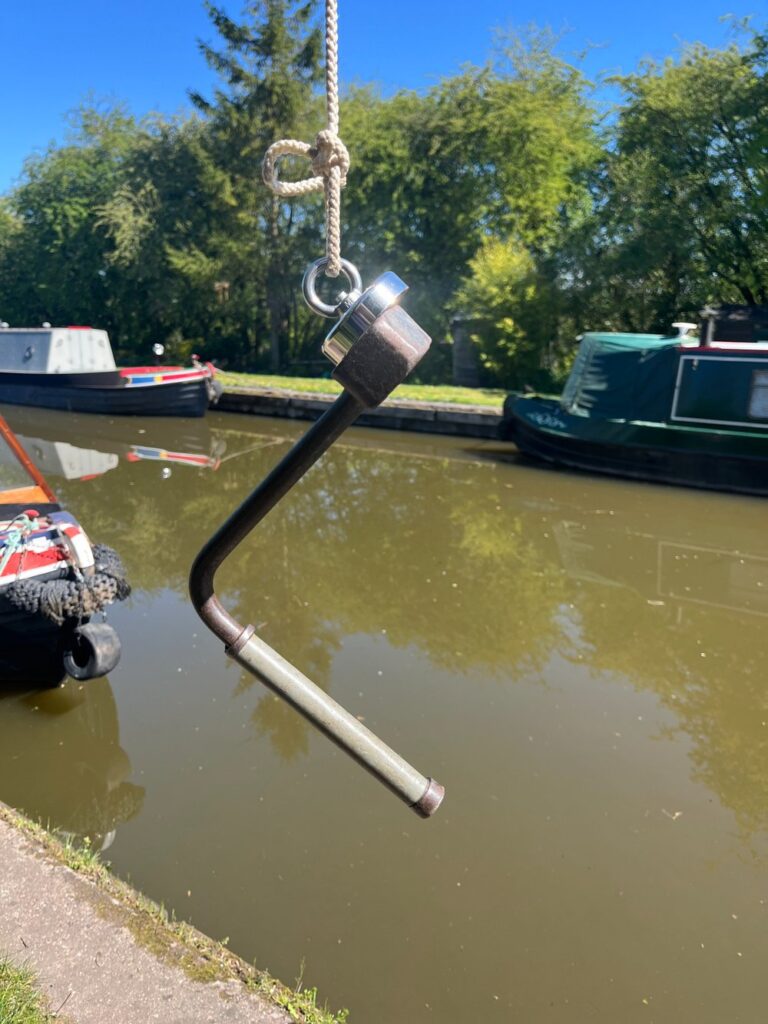
A couple of locks earlier, there had been another splash, a noise that rarely bodes well when boating. This time, it was a lock key that had entered the water, just outside the lower lock gate. We were about to give up the search when Lewis retrieved it with a magnet attached to a cord.

Such setbacks are just the norm for negotiating a large lock flight and the hassle involved was very much outweighed by the gratitude I felt for all the help. It would have been very slow and arduous work on my own.
From previous experience, I was aware of what can happen if you moor for the night part way up a lock flight through weariness. You end up eating your dinner at a twenty-degree tilt as the water in the small lock pound drains away due to a leaky gate.
I was also grateful to these friends for all that they had taught me. Rather than the large premises of my pottery classes in Southport, these classes had been conducted in a shed in Tracy’s back garden. One of the joys of these classes was that Tracy and Jess insisted that their clients did no tidying up, a task that normally takes about fifteen minutes, for a naturally messy potter.
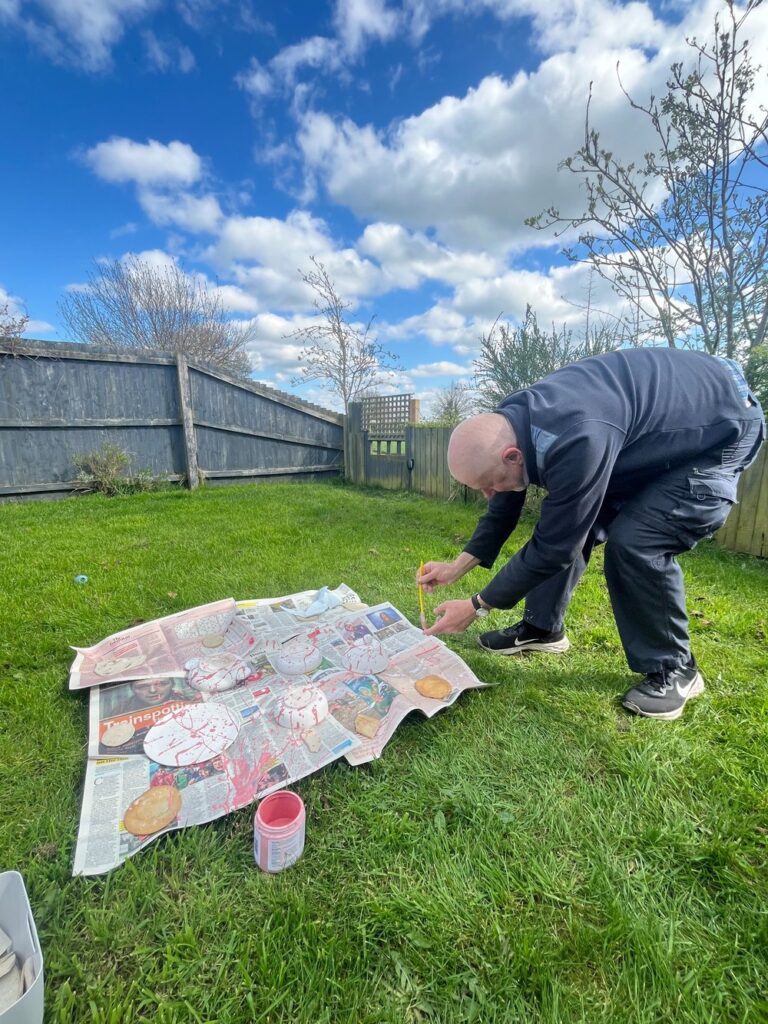
I took this messiness to an extreme when I decided to experiment with a Jackson Pollock technique for glaze application. First on a soup tureen, bowls and plate, and then on one of a pair of jugs.
Rather than the “double-pendulum approach” of Jackson Pollock, which would have been rather wasteful of expensive glaze, I used a spatula. It is surprisingly difficult to achieve the appearance of randomness. You need to develop the correct technique merely to achieve some extended splash-lines.


When googling for things to do in Nantwich, the other item that caught my eye was Drum for Fun with Steve. For the first few lessons, while deciding whether it was really my thing, I improvised by using an upturned bucket for a snare drum, three paint cans for tom toms, a squeaky dog chew for a bass drum and pedal, a squeaky dog chew with a slightly different noise for high hat and pedal.
Steve is a very patient and well organised tutor. He would sit at one set of drums, and I would sit facing him, at another. On a side wall was a large screen on which musical notation would be displayed, and on a sideboard was a music deck, so that we could play along to music tracks. From Steve’s quiet manner, one wouldn’t have guessed that he was the drummer in a 1970s punk band called Trash that released a chart single. After a few lessons, I bought a small electronic drum kit.

Another feature of life in Swanley Bridge Marina was a knock-knock on Mary Joan’s hull at around 3pm, when Don, on the next boat along in the marina, would finish his day’s restoration work on his boat, and invite me round for a cup of tea and to pass judgement on it.
As Don had taught various mechanical engineering subjects at school, and tutored a group of his pupils to victory in the The Great Egg Race, I restricted my opinions to the aesthetic aspects of his project.
We had a shared interest in lightweight historical fiction. He is a fan of Patrick O’Brian’s Aubrey-Maturin series. I am more inclined to George Macdonald Fraser’s Flashman series. I read Patrick O’Brian’s “Master and Commander”, the first in the Aubrey-Maturin series, but could never get past the Weevil joke and so read no more.
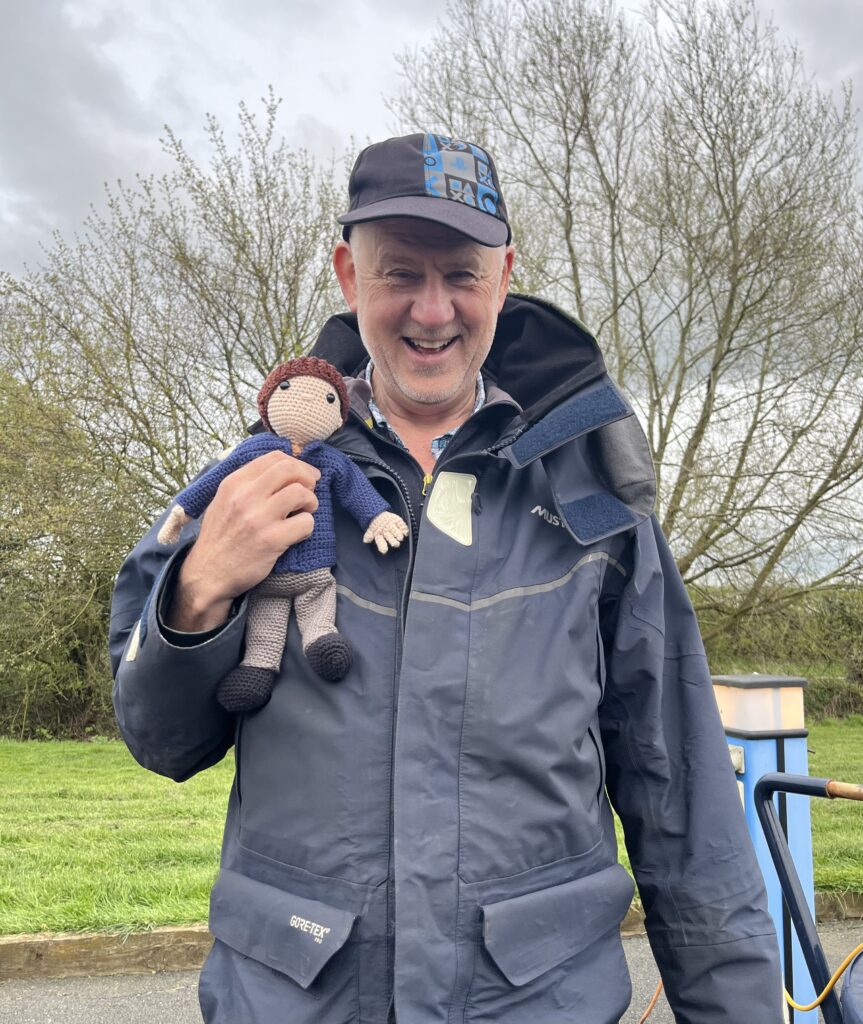
Late in the season, Paula and Clare, arrived at Swanley Bridge Marina in their beautiful boat “Blanche” and Paula knitted a doppelganger of me. Paula’s brother is Andy, who wrote a guest post on this blog.

Andy is a fan of more heavyweight historical fiction (Hilary Mantel) and keener on historical accuracy and so advised Paula to give the doppelganger a large belly. Fortunately, Paula ignored this advice. A Jackson Pollock style jug headed in the opposite direction to complete the creative exchange.