Walking the four-mile stretch of canal from Gayton Junction to the centre of Northampton (The Northampton Arm) in search of some warm winter pyjamas, I found that as I approached Northampton, the canal had an increasingly forlorn appearance with graffiti, however quirkily uplifting, playing its part.
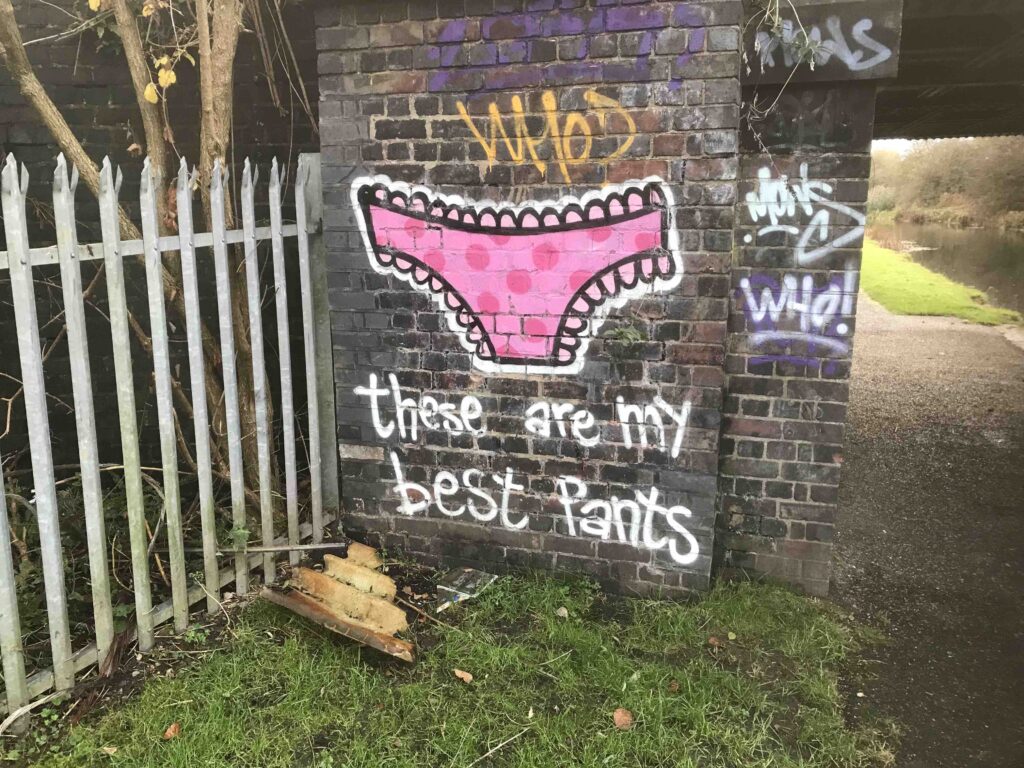
In the late 1970s, when I was about fifteen, I watched a live televised schools’ debate in which Dennis Healey was the guest of honour. He was the Chancellor of the Exchequer for the Labour Government of the day, and famed for having recently raised the top-rate of income tax to seventy five percent, and for having exceedingly bushy eyebrows.
A series of pupils ascended to the microphone and asked him scripted questions. It must have been Sunday tea-time, with my parents and brothers all gathered around the TV, because such dull fare would not normally have been my choice of viewing.
I was barely listening when a lad of about my age approached the microphone – “This economic theorising is all very well Dennis, but what we really want to know, is how big is your willy?”. The sound of an audience drawing in its breath suggested that I hadn’t misheard. A jam scone probably hovered motionless at my lips. This was an era when the nation’s youth knew their place. Even questioning the quality of a jam scone was pushing your luck. Dennis paused for a moment before announcing “Big enough”.
Healey’s seventy five percent top-rate of income tax may well have been the trigger for the setting up of tax havens, such as the British Virgin Islands. Havens that have subsequently enabled the bean counters of the super-rich to set up companies with opaque ownership to avoid paying tax.
Move forward half a century and we have the Conservative MP and barrister, Sir Geoffrey Cox, representing The British Virgin Islands (in his “spare time”) as a QC in the territory’s attempt to avoid having to reveal the ownership of the companies registered there. Dennis and Geoffrey, through a combination of left-wing dogma, and right-wing cynical greed, have contributed to the creation of the tax environment that has enabled the Amazons and eBays of this world to hollow out the high streets of the towns that I have encountered on my recent travels, Banbury and Northampton.
Fifty years ago, their high streets were thriving, and dotted with interesting, small speciality shops. Now, it’s largely betting, charity, and coffee shops with some dull chain stores, grimly hanging on at best, boarded up frontages at worst, and a general aura of decay. The speciality shops that were once owned by the craftsmen and women, haven’t entirely disappeared. They now appear in strange places, like The Blisworth Floating Market.
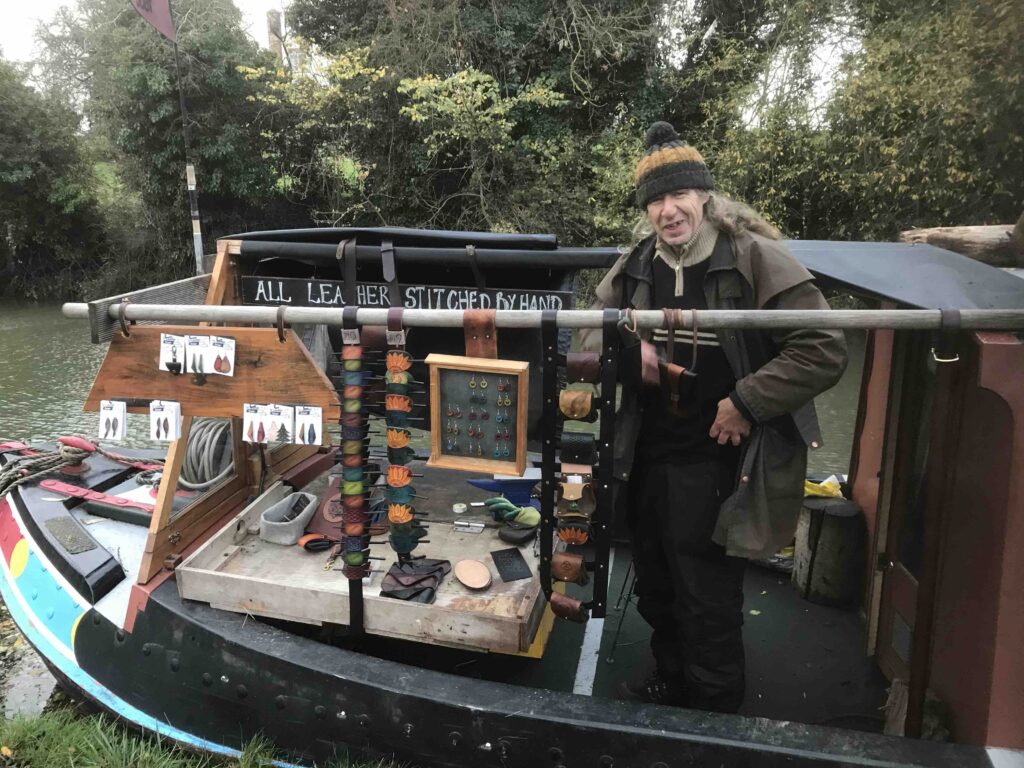
This is Paul, from whom I bought an exquisitely constructed leather coin-pouch, and who once lost a million pounds in shares. He has no regrets, as he wouldn’t have otherwise chanced upon the lifestyle in which he’s been able to turn his hobby into his income, while cruising at leisure, on England’s waterways.
On another boat in the market, I found Nicky, who sells sewn and knitted goods, and who has offered to convert some material, that was bequeathed to me by Mary Joan’s previous owners, into new sets of curtains, for the very reasonable cost of twenty-five pounds per set.
I am probably more in the thrall of Amazon than most. Its lockers, pick-up points, and speedy delivery make the life of a continuous cruiser that bit easier. I didn’t ask Nicky whether she’d be willing to darn the hole in my third-best pair of pants. It is even more unlikely that she’d be interested in the size of their contents.
